


It began with nothing more than the faint repetitive drip-drip-drop of a leaky faucet. Except when he searched the bathrooms and the kitchen, Harold couldn’t find any leaks. No water anywhere that wasn’t supposed to be there.
It was just annoying at first. He called in a plumber, but they couldn’t find a leak and didn’t even hear the dripping sound that so bothered Harold. Soon it was keeping him awake at night. Drip. Drop. Plop.
It was never-ending.
The next debate was coming up, and this mayoral campaign was running closer than he’d like, so he had his assistant book a room at the Hilton in town for the two nights leading up to the event. At least he could get some sleep and be prepared.
But the sound of dripping water followed him to the hotel. If anything, it was louder than at home. He called in to the front desk, and they sent a plumber, but he found no leak. Harold changed rooms. The dripping sound followed him.
Midway through his first night at the hotel, he gave up and went back home. At least he could try and get some work done if he wasn’t sleeping.
Harold settled in at his desk with a tumbler of scotch and his laptop, prepared to work until sleep finally claimed him in spite of the small wet splats he could now hear no matter where he was.
Halfway through tweaking the speech for an upcoming press conference, a line of cold trickled down his neck — the hairs along his spine standing up as his skin lumped into goosebumps. He shivered and stood to grab a sweater and maybe turn up the heat.
As he stepped around the desk, there was a flicker of bright yellow movement in the corner of his eye. Whipping his head around, he looked, but there was nothing except a small puddle of water on the floor in the doorway.
He eyed the water curiously, looking up at the top of the doorframe, but there was no indication of dripping water. Sighing, he turned up the heat, grabbed his handkerchief and mopped up the small puddle, before going back to work.
As he settled back into his ergonomic chair with a sigh, Harold noticed an email on the screen that he didn’t remember opening. It was a message the former mayor had sent to him over three years ago — just two months before the flooding that had destroyed the section of town known as Old Briar.
He quickly hit the trash icon to delete the message. He didn’t need any reminders about what had happened when the levee broke and the lower portion of Havenbrook was inundated with water that rose far faster than anyone could’ve predicted.
He took a swallow of the scotch, followed it with another sigh, trying to clear his mind to focus again on his speech. Ding! The sound indicating a new email came through the laptop’s speakers, and he flipped over to check it. The same email he’d just deleted showed on his screen, and he angrily trashed it again.
Pausing, he moved to the Trash folder to check the sender, but the email wasn’t listed. It showed his last deleted email as a message from his assistant about the Hilton room.
Frowning, he shut the email app and went back to tweaking his speech document. Half an hour later, he was eyeballs-deep in adjusting the language in the speech around how he planned to address education cuts coming from the state when his phone beeped with a text.
Unknown: Why did you do it?
Muttering under his breath in irritation, he blocked the number and deleted the text. His phone wasn’t supposed to accept texts from blocked or unknown numbers.
Before he could even set the phone down, it beeped again with a new message.
Unknown: You let us die.
Harold’s breath caught as his eyes locked onto the words. What the hell? Frantically, he began trying to figure out who had sent the message, but there was no number provided, and no sign that the sender’s info had been blocked.
He eyed the phone as though it might bite him, waiting for another message. But it remained black and silent in his hand. As he waited, he considered asking his IT support to trace the call, but then they’d see the message. That wasn’t an option.
After ten minutes, he carefully sat the phone face-up on the desk, so he could see immediately if a new message came in. He turned back to his laptop and tried to work on the speech, but his concentration was shattered. A few minutes later, he gave up and leaned back in the chair to try and catch a little sleep.
He knew it was a dream immediately, though he couldn’t have said how. It was realistic, so there was nothing to tell him it wasn’t real, but he knew.
He sat at a back table in a local pub called Gallagher’s. Across from him was a middle-aged man in a very nice suit, with a watch studded with diamonds that caught the faint light and seemed to amplify it.
This meeting had really happened. He remembered it clearly — about three-and-a-half years earlier, he’d met with Jacob Anderson to discuss his political future. The future he was now living in.
And now he was here again. And Jacob was sliding the piece of paper across the table. And he was turning it over and looking at the words and numbers written there: $10M. OB -> EG. 2yr.
And he’d nodded his agreement. He’d done as they asked and shifted the infrastructure funds from Old Briar to East Glenwood.
And two months later, the river had flooded to historic levels. The levees at Old Briar had broken, and hundreds had drowned. Thousands homeless. Millions in property damage.
Just as it had happened in real life, Anderson got up and left the table — left him sitting there. The wealthy industrialist had taken the paper with him. And Harold had just sat there, nursing his 40-year-old Macallan — something he could never afford on his own back then.
But Anderson had come through. Because of the added danger presented by the deaths, he and his group from East Glenwood had donated $20M to Harold’s mayoral campaign.
Just like last time, Harold slowly drank his whiskey, savoring the rich, peaty flavor. As he tossed back the final swallow, he choked and spat — the oaky musky whiskey was suddenly cold, silty and rancid. Gritty soil grated between his teeth as he coughed and choked out the nasty liquid onto the table.
And then his eyes were open. He was awake and still choking on dirty water, coughing it out onto his white t-shirt. But it was clear. Saliva. He’d dreamed the whole thing.
As he caught his breath and got his choking and coughing under control, he rubbed tiredly at his eyes. He hadn’t slept more than an hour or two in days. Rubbing at the wet spot on his chest, he groaned and reached for the half-empty tumbler on his desk.
“Gotta get this shit under control, Harold,” he muttered to himself, running a rough hand through his thick salt-and-pepper hair. It’d been entirely brown four years ago. And thicker.
Knowing more sleep wasn’t likely tonight, Harold turned back to his laptop and yelped in surprise. There was a face on the screen saver. For just a moment, he didn’t recognize the boy. Dark skin ashy, gaunt cheeks with big brown eyes and pale brown lips, his hair in tight curls against his head.
His name was Micah Everett, and he’d died in the flood. He’d been a poster child for the news agencies who’d shown his photo over and over again, decrying this death even as they profited from it.
His uncle — Trey Everett — was now running against Harold for mayor.
Suddenly, it started to come into focus. This was some kind of plot by his opponent to bring him down before the election.
“Bastard,” he growled angrily.
He jabbed his finger at the keyboard to wake the machine and dislodge the screen saver — and that’s when the boy’s eyes moved. Not blinked. Shifted. Focused. Like he’d been staring past Harold this whole time… and now he was looking at him.
Then the boy’s eyes widened, his mouth opened and liquid began to pour from it in a waterfall of dirty river water.
Harold recoiled and slammed the laptop shut. He would not be manipulated by some asshole wannabe politician from the wrong side of the tracks. He’d been the mayor for over two years now, ever since Thomas Jordan had been forced to resign after the flood. Thomas had taken the heat for the whole thing.
Harold stood and left his office in a huff. A quick call to his security guard ensured they’d scan the property and also check wi-fi, ethernet and phone lines, the lot. They’d make sure no one else could get to him. They’d even supply a new iPhone by morning, complete with a new number.
He’d end this shit right fucking now.
Stomping up the staircase, he was lucky to be gripping the banister tightly as his foot slipped in a small puddle halfway up. A sharp yank on his left shoulder, his shins and knees slamming into the wooden steps, he cried out in pain as his head bounced off the top step.
His vision went black for a moment — and in that moment, he saw Micah Everett clearly, as though they were face-to-face — and then his vision cleared. He groaned as his joints ached and the bruises bloomed on his pale skin.
He shouted — screamed — for Inga, his housekeeper. “Clean up this goddamn water, Inga!”
A few moments later, the sound of a bedroom door opening on the ground floor was followed by running footsteps, and Inga appeared at the foot of the stairs in her housecoat, her hair up in a kerchief.
“I’ll take care of it right now, sir,” she said in a sleepy voice, producing a towel from a voluminous pocket and heading up the stairs toward him. “Shall I call in some assistance?” she asked as her eyes scanned the rich mahogany wood of the steps.
Then she paused, brow furrowing in confusion. “I don’t see any water, sir,” she said quietly, glancing up at him.
Harold could almost see the judgment in her icy blue eyes. She thought he was drunk and had just tripped. Bitch. Or maybe she’d left the water there herself — maybe she was working for Everett.
“It was there. I felt my foot slip on it,” he spat at her. “Get it cleaned up right fucking now.”
She just nodded and said nothing as she moved toward the spot on the stairs where he’d pointed. But he could see the heat of her judgment radiating from her like heat.
Grimacing, he dragged his battered form upright and trudged toward his bedroom. He needed a soak, some ibuprofen, and another scotch.
He heard Inga humming behind him as he walked away.
Harold locked the bedroom door behind him. Then he locked the bathroom door. He began to get undressed, then checked the door again. And the window. All locked.
With a sigh of relief, he dropped the rest of his clothes on the floor and started the water in the tub, hot as he could stand it. He sat idly on the edge of the tub, running his hand under the faucet and staring into the mirror at the tired, middle-aged man with the sagging physique, the thinning hair and the bags under his hollowed-out eyes.
He was never going to get reelected looking like this. He had to get his shit together now. Tonight. There was no time for this harassment to bring him down.
He jerked his hand back with a snarled, “Fuck,” as the water suddenly went frigid against his warmed fingers.
He turned the cold water all the way off and the hot water all the way up, but every drop pouring from the faucet was cold. And as he looked closer, he realized the bottom of the tub held a layer of dirty silt. Confused, he reached into the water. As he ran his fingers through the mess at the bottom of the tub, he realized the silt wasn’t just dirt. It clung like shredded moss, like the threads of someone else’s clothes.
His eyes welled with frustrated tears as he stared into the dirty water. He just needed to rest. To relax. To not think about all this for a while. Why couldn’t he just take a goddamn nap?
He shut the water off resignedly, grabbed his robe, and headed for the bedroom, giving up on the bath for the night. He hit the light switch on his way out the door, only to stop as he caught a glimpse of yellow in the mirror over the bathroom sink.
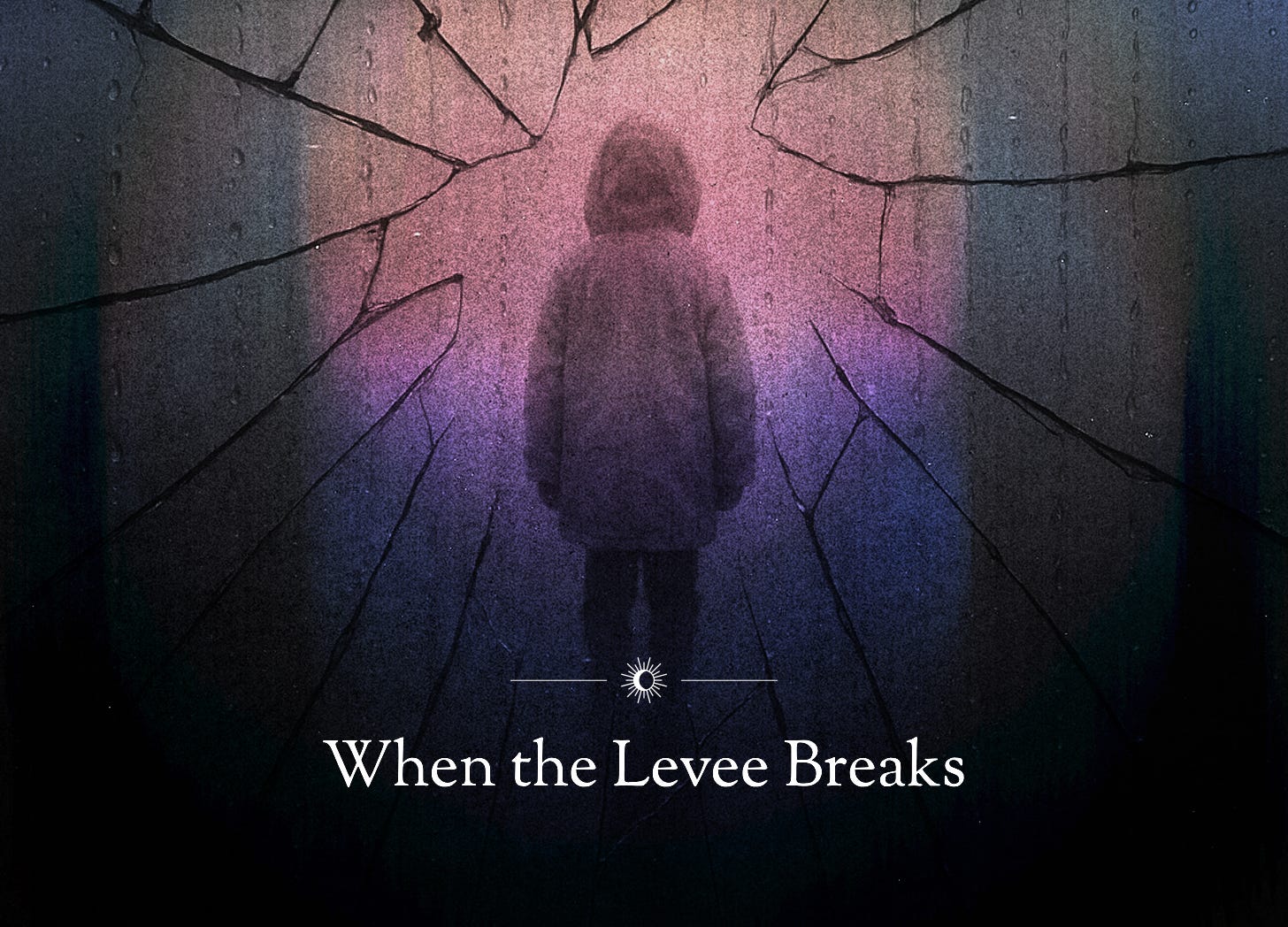
Frowning, he stopped and flicked the switch again. The light flashed on, and staring at him from the mirror was little Micah Everett, dressed in a yellow rain slicker and galoshes. The boy’s face was ashen, and his lips were tinted like they’d been brushed with midnight and periwinkle.
The boy’s brown eyes had paled to an eerie-looking gray, and as he stared at Harold, his lips parted as if to speak — What do you want? Harold wanted to ask — but instead of words, out poured more of the murky water in which the boy had drowned.
With a strangled cry of fear, Harold flung his mostly empty tumbler at the mirror, and the glass shattered with a crash. As each piece struck the tile, it made no sharp crack — only the soft, sick splash of droplets hitting a pool of blood.
Harold fled the bathroom without another glance, slamming the door behind him.
He spent the rest of the night sitting rigidly on the end of his king-size bed, wrapped in his velvet bathrobe, woolen slippers on his feet, drinking expensive whiskey directly from the bottle. His gaze rarely left the bathroom door, unless it was to check the main bedroom door or eye the level of whiskey left.
As the pale light of dawn crept through the crack in his curtains, Harold heaved a sigh of relief. With the coming of daybreak, his life could resume its normal patterns. He cautiously opened the bathroom door to find the room looked just like always, aside from the shards of mirrored glass littering the floor and counter.
Feet protected by his slippers, he turned on the shower and prepared to start his day. As the water heated, he eyed himself in the remnants of the mirror still attached above the sink — sunken eyes surrounded by darkened, bruised-looking skin, pasty skin, and pale lips. He turned away with a shudder as he realized his features echoed those of Micah Everett.
He hung his robe and stepped into the shower, sighing with relief at the sensation of hot water pounding against his taut shoulders.
With the heat relaxing him, he didn’t initially notice as the water level began to rise around his feet. But as the temperature of the rising liquid dropped, his eyes popped open. Looking down, he found the drain clogged with thick streamers of dirt-covered cloth, and the water level rising far faster than could be explained by the showerhead.
Yelping, he shut off the water and pushed at the shower’s clouded door. It didn’t budge, and the water continued to rise. It was up to his knees as he began to yell for Inga or security or anyone to help him.
As he clawed at the door, he saw the small yellow shape silhouetted through the semi-opaque glass. A faint voice trickled into his ear like cold drops of rain — a child’s voice that said quietly, “I cried for help.”
Harold screamed louder and beat frantically on the glass, but it didn’t even shake in its frame.
A moment later, the bathroom door burst open with a crash as his security team rushed into the room and pulled open the shower door, dropping him unceremoniously onto the bathroom floor, his naked body sliding wetly across the tiles.
No water poured out with him.
The security team had eyed him strangely, but they’d said nothing as Harold sent them away angrily. With a growing sense of despair, he dressed and prepared for another day at the office — as though it were any other Wednesday.
As he strode through City Hall, he didn’t register the way people eyed him as he passed — wrinkling their noses at the strong odor of alcohol that hung around him like an invisible mist, frowning at his back as his steps faltered and weaved, and eyeing the way his thinning hair stuck out strangely from his head.
He noticed none of it until his secretary, Tina, furrowed her brow with concern and asked how he was feeling. Suddenly aware of himself — of how he appeared — Harold asked for a large coffee, black, with three sugars, said he hadn’t slept well, and sent the secretary away.
Then he went into his private bathroom — not without some trepidation — rinsed his face in cold water, patted his cheeks, and straightened his hair, pressing it down with cold water from the tap.
He shut the bathroom door firmly behind him when he stepped out.
He sat at his desk and went to work, sipping at his scalding coffee as though it were a lifeline to sanity. Paperwork was oddly grounding. The repetition and familiarity of it helped him to center his mind. He filled out requests, responded to messages, and signed documents.
It was all going well until his gaze caught on a paragraph on the page he’d just completed. His eyes widened in panic as he read what he’d signed: I did it. I reallocated the infrastructure funds from Old Briar to East Glen. I got campaign support for my efforts. I killed them.
With a sob, he tore the page into pieces, ripping it again and again into tiny pieces as he moaned wordlessly. Tina rushed into the room, worry clear on her face. “What’s wrong, sir? What are you doing?”
“Why would you give me this?” he snarled at her. “Why? Why would you want me to say that?”
Frowning, the secretary snatched at one of the shreds, scanning it carefully. “It’s the latest budget update from your campaign manager. You said you wanted to see it and sign off when it came in?” The question was loaded with doubt.
“I saw what it said.” His voice was a mixed growl of fury and sleeplessness. “I won’t admit to that. I won’t.”
Tina’s expression and tone went carefully neutral in an instant. “Of course. Whatever you say, Harold. Shall I let them know the new budget isn’t approved?”
He yanked the scrap of paper from her hand and glanced at it. It said nothing about Old Briar or East Glen or him moving infrastructure funds. It indicated his campaign manager had decided to reallocate funds to more television and online advertising.
“Get out,” Harold snarled. “I’m not to be disturbed.”
Once he was alone, he sank back into his chair and cradled his head in his hands. And he cried. His tears were cold and left gritty trails on his cheeks.
Exhaustion finally won, and he fell asleep in the chair, head atop his arms, back and shoulders hunched as though he was expecting a blow. He slept there for several hours — long enough for City Hall to become largely empty as the workday ended.
When he woke, dusk had just fallen, the faintest hints of the autumn sunset still peeking through the windows. As he lifted his head and looked around the office, Harold found he was not alone at all. The room was filled with people — more people than he could easily count.
They were in various states of dress, some in coats and boots, others in housecoats and pajamas, still more wore nothing more than underclothes or dressed in sweats or jeans. There were white people, black people, and brown people. Young, old, and every age in between. They were crammed into the room with no space between them.
They all had one thing in common — all stood ashen and silent, staring at Harold, and all of them had water pouring from their open mouths.
Harold screamed. He stood and tried to run, but the forms of the dead crowded around him, and he couldn’t push past their cold, rigid frames. He fought and clawed. The dead didn’t harm him. They just stood, implacable and unmoving.
With a cry of desperation, Harold turned away from the door and threw himself at the window. His body shattered the glass as easily as his tumbler had broken the mirror the night before.
Unlike the mirror, he landed four stories below in one piece. One very broken piece.
—
‼️ If you liked this story, you may want to read some of my other fiction.
💀 Did this story make you shudder? Buy me a cup of existential dread, and I’ll keep the creepy coming.
Even though, I am not a fan of creepy stuff, I was totally pulled into the story. I love your use of similitude and showing rather than telling. The plot coming full circle is quite satisfying to me as a reader. Great job.
Great build with some really nice tension, and truly terrifying visuals. Old Harold finally got some well-deserved rest. Good riddance!