

This was written in response to Power-Up Prompt #23 from The Writer's Journey.
The prompts were:
Setting: The Ghost Town
Character: The Disgraced Deputy
Conflict: Delivering Justice
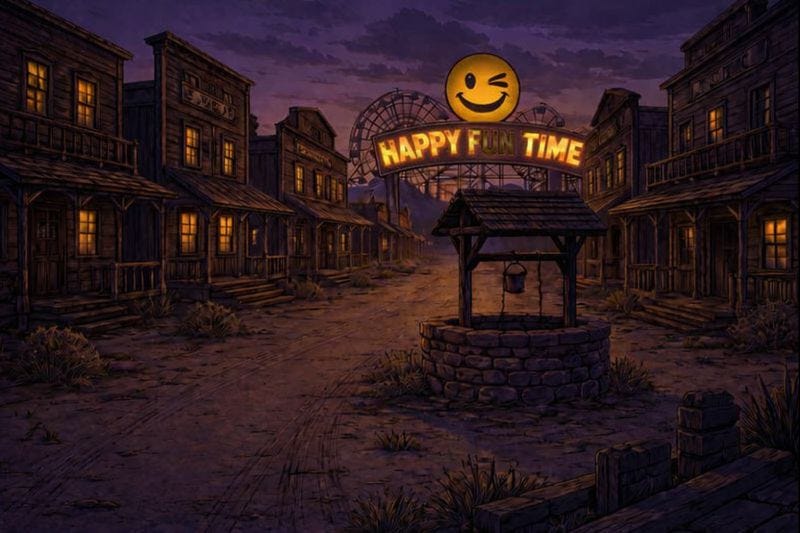
As Seela watched, a tumbleweed bounced up and down the street, passing empty wooden storefronts, an old well, and an abandoned barn. One slender eyebrow rose in amusement as a second tumbleweed chased the first.
She was fairly certain the tumbleweeds were a man-made addition to the ghost town section of the Happy Fun Time amusement park. But subtlety had clearly not survived the end times. What might once have been a timed, occasional mood-builder was now constant. A torrent of overdone western symbology.
She strode down the empty dirt path of the faux Main street, eyes darting back and forth as she looked for signs of her quarry. She’d been given his name — Doctor Marco Janz — by the last man she’d hunted. Dr. Jonas had claimed Janz was the mastermind behind the virus that had destroyed much of humanity.
He was also possibly the only hope they had to find a cure.
A twitching motion in the corner of her eye drew her gaze like a laser. Her head snapped around and she sped her pace toward the dusty old tavern. He had to be here, of that she was sure. She’d been hunting him for months, hoping he’d have the answers they all needed.
Seela pushed through the swinging half-doors, the creaking hinges a shriek in the falling dusk. A man’s silhouette cowered against the far wall near the stairs — tall, thin and radiating fear. She paused for a moment, surprised by the lack of arrogance.
Jonas had been so full of himself his ego had preceded him by several feet with every step he took. As soon as she’d entered the room where the man stood, his overwhelming confidence had been a wall of suffocating heaviness on her chest.
But Janz — if this was him — was nothing like that. There was no weight to him — no arrogance or insistence on his own importance pressing back at her. What she felt instead was something smaller. Quieter. An awareness of scale — of how little room one life took up once the world was considered whole.
“Dr. Janz?” she called out, keeping her voice soft, working to rein in the aura of threat she usually projected to keep herself safe.
There was a long pause before a wavering response came, “Y, y, yes?”
“I’m Dep… Seela Gardener. I’ve been looking for you.”
When he answered, his voice shook — not just with fear, but with regret. “I didn’t do it on purpose. It was an accident!” The unspoken words — please don’t blame me — rang in her ears.
“I’m not here to hurt you,” she answered quietly. “Let’s sit and talk.”
She settled herself in one of the faux-wood chairs surrounding the dusty round tables in the large space. Hesitantly, the slender man crept out from the corner and approached. He was even more gaunt than his shadow had suggested — he looked like he hadn’t eaten or slept in years.
Maybe he hadn’t. His emotions were all over the place, but his guilt was almost overpowering.
She smiled gently and gestured toward a nearby chair. Janz carefully lowered himself across from her — staying carefully out of reach — and watched her with wide, bloodshot eyes.
“Do you want some water?” she asked, sliding her canteen across the table.
He snatched it, had the lid off and was slurping almost before she could pull her hand back. She wondered how long he’d been alone and desperate as she watched silently. When it seemed clear he might drink it all, she raised a hand. “You should stop. You’ll make yourself sick if you haven’t had much to drink lately.”
He reluctantly rested the canteen on the table and licked cracked lips. He tightened the lid back on and sighed as he pushed it back across the table. She accepted it with a tight smile, feeling the emptiness of it.
Janz must’ve noticed her eyes darting toward the well in the center of the fake town, because he shook his head. “It’s not real. No water in it,” he explained.
She nodded. “Then what made you stop here?”
“No people. I didn’t want to see any more people.” The wave of sorrow and guilt that accompanied his words hit like a hot brick to her chest.
“Yeah, I can get that. People aren’t safe anymore.”
“They never were,” he answered in a voice full of pain.
Reaching into her pack, Seela pulled out some jerky and pushed it across the table. As Janz grabbed for the bag and began to gnaw on her home-cured venison, she began to talk. This man needed to be put at ease before she could get him to help — or at least, he needed to be less tightly wound than the coiled spring of fear and regret she felt now.
So she began to tell her story.
“I was a sheriff’s deputy in a small town in Nebraska,” she began. “Before the virus came, I’d only had my badge a couple of years. Lots of cops in my family.”
Janz said nothing as he kept chewing — the meat was tough and would keep him busy for a while — but his eyes were locked on her every move. He was waiting for the attack he expected to come any moment.
So she stayed carefully still and just kept talking. “I’ve always been able to tell things about people. Once I met them, sometimes I just knew when someone was carrying charges they hadn’t earned. Or owning guilt they’d escaped accountability for.”
“Empath,” he muttered through a mouthful of half-chewed deer meat, looking interested in spite of himself.
Her eyes widened — it was rare anyone recognized or could name her ability so quickly, if at all.
With a nod she continued, “Things like that run in my family. Anyway… I struggled as a cop because sometimes I knew who’d done harm but I couldn’t prove it. Or I knew someone was innocent, but the evidence was overwhelming.” Her shrug was tense with frustration. “The law didn’t care what I knew. It only cared what I could prove.”
Janz’s chewing had slowed and he stared, rapt, as her story continued.
“It was… hard — watching bad people go free because we couldn’t prove their guilt. It was worse watching good people locked up.” She paused and looked down at her where her hands curled together in front of her. “But the worst was seeing the people around me — other cops, lawyers, judges — not caring if we got it wrong.”
The scientist’s expression grew softer, and he nodded. “Yes. The system was…” His voice trailed off as he shrugged, thin shoulders rising and falling with shared frustration.
Closing her eyes for a long moment, she took a breath and went on. “Yes. It was. So when I found a truly bad man — evil — but I couldn’t prove it…” Her voice trailed off, and her shrug mirrored his.
They sat in silence for several seconds. “What did you do?” he finally asked.
When she answered, her voice was matter of fact. “I set him up. Let him think I was a victim. When he attacked me, I hit him. Just once. But…” A dark smile appeared for just a moment on her face. “I did something else. Something I’d never done before.”
He leaned forward in his chair, eyes wide.
Her gaze lifted and her brown eyes met his blue ones. “I imposed myself on his mind. I made him feel everything his victims had felt — over and over again I made him feel the terror and the pain and the violation he made those women feel.”
Her voice grew colder, losing the melodic edge it had carried so far. “I trapped him in it. Looped the experiences for him. I left him a drooling vegetable.” The satisfaction in her tone was unmistakable, and Janz sat back in his chair, once again looking afraid.
“I’m… I’m guilty,” he said quietly. A confession she didn’t need — a truth, but not the whole truth.
She’d told her story. Now it was his turn, and he knew it. She waited silently.
Janz released a long sigh and collapsed back in the chair — his back folded until his elbows rested on his knees, face buried in his hands. When he spoke, his voice was only slightly muffled by his palms, and the plaintive tone was crystal clear.
“It was supposed to help people.”
Seela winced at the wave of regret that hit like a backhand.
“It was supposed to be the ultimate anti-depressant,” he explained. “It was supposed to help people turn off grief, sadness and depression. It was going to help people deal with the worst moments of their lives…”
Another long pause before the words began again. “But it didn’t quite work the way it was supposed to. It could shut down emotions, but it could also stimulate them. All emotions.”
Seela watched, staying silent and still — absorbing the powerful emotions that emanated from him in waves as the story continued.
“When corporate saw that it could stimulate rage, they decided to try and sell it to the military. But I refused to make it stronger. So they asked Zeke Jonas, and he agreed to it. After the demo, it turned out even the military didn’t want it. ‘Too volatile,’ they said.”
He huffed a disgusted laugh. “If even the military doesn’t want it, you know it’s bad.”
“It was never supposed to be contagious. It was going to be a prescription. But while they were tinkering with it, they figured out they could make the change permanent if they introduced it as a retrovirus. They’d have charged an arm and a leg for it then.”
As the explanation progressed, his words sped up until they were flowing from his lips in a river of excuses. It was clear he’d been needing to tell his story for a long time.
“I warned them. I told them not to keep tinkering with the genetics, but they had visions of dollar signs dancing in their hearts. And then…” The words finally slowed to a trickle then stopped. “Then Mike was infected.”
“Mike?” she asked.
“Mike Leashman,” he answered as though that explained it all. It didn’t. She just raised her eyebrows in a question.
“He was a lab tech. No one knows how he was infected. No one even knew he was infected at first. We all just thought he’d come down with the flu that was going around. But that’s when it got out. He went home from the lab, stopped at a pharmacy, then the grocery store. And it started to spread.”
Well, she finally understood how it had happened — this was the information she’d been hunting. But it wasn’t the answer she’d hoped to find.
Janz sobbed once — a broken sound — and the wave hit her again, pushing her back in her chair with its weight of guilt and regret. “I never meant for it to happen. I never meant for any of it. I tried to find an answer — a way to fix it — but I couldn’t.”
There was really only one question left to ask. So she did.
“Do you think if you had more time you could find a cure or a fix?”
He stared at her, surprised by the lack of condemnation in her voice. “I… I’m.. not sure?” Then he shook his head sadly, “But I don’t think so. I think it’s mutated too far now. It’s been in the wild too long.”
That was the answer she’d expected. But not the one she’d wanted.
She nodded — calm and matter of fact. This man had been punished enough. Nothing she did would make his life worse than he’d already made it.
She pushed the mostly empty canteen back across the table at him and slowly rose. “Well then, I guess we’re done here. Probably best if you stay away from people as much as you can. It’s not safe.”
His surprise was evident for a moment — he’d expected punishment. Then he nodded. “Okay,” he answered simply. “Thanks for the food. And… for listening.”
Seela smiled briefly, sadly. And then she turned to leave. Time for the next hunt to begin.
—
‼️ If you liked this, you may want to check out some of my other fiction.
Did this story tingle your spine? Buy me a cup of existential dread and I’ll keep thrills coming.
Particularly liked the restraint in this one. No revenge porn!
OH. MY. YES!!!!!!!!!!!!!!!!!!!!!!!!!!!!!!!!!!!!! 🤠🤠🤠🤠