

This is a post-apocalyptic world I’ve been thinking about for a while, but this is the first time I’ve written a full story in it.
It was written for Bradley Ramsey’s first Narrative Feast entry.
Five years ago the fog rose everywhere all at once, and I do mean everywhere. There was only a small section of Antarctica that wasn’t affected, though we didn’t know that at the time.
It was a dark green mist that rose from the earth itself. It ignored barriers like walls, filters, even water. It started below the surface of the earth and rose all the way into the thermosphere — there was no avoiding it.
Some people it killed quickly, though they died in agony, their skin sprouting sores that grew into poison nettles so they were ripped apart from both inside and out, even as the poison increased their pain and rendered them unable to move beyond moans and tears.
Only a rare few were completely unaffected — maybe .01% of the world’s adult population, the very young, and the astronauts who were off-planet when it happened. The unaffected were the best of all humanity, those unique individuals who cared about the planet and about their fellow beings more than they loved themselves.
Then there was everyone in between — there was me.
I wasn’t a bad person. In fact, I often told myself I was a good person. Now that I can’t hide from myself, I know the truth is somewhere in between. Mostly I was a lazy person. I was self-absorbed. More interested in my own comfort and convenience than in doing the right thing.
I used to be sheriff in a small town in Missouri. Nice place. Good people. Mostly. But not good enough to be spared by the fog. Actually, the number of them who died quickly surprised me. But most were like me — changed, not killed. The only ones unaffected were the children under six years old.
Many of them changed later, of course. But that’s just how the world works now. The earth is always watching.
I’m still the sheriff, I suppose. I don’t wear a badge anymore, but I’m still a protector. I don’t really have a choice. The earth gave me the ability to do the job I was always supposed to be doing.
I used to investigate. Sorta. I asked a lot of questions until I figured out what was going on, and then I dealt with it. I don’t really need to ask questions anymore. Now my body tells me.
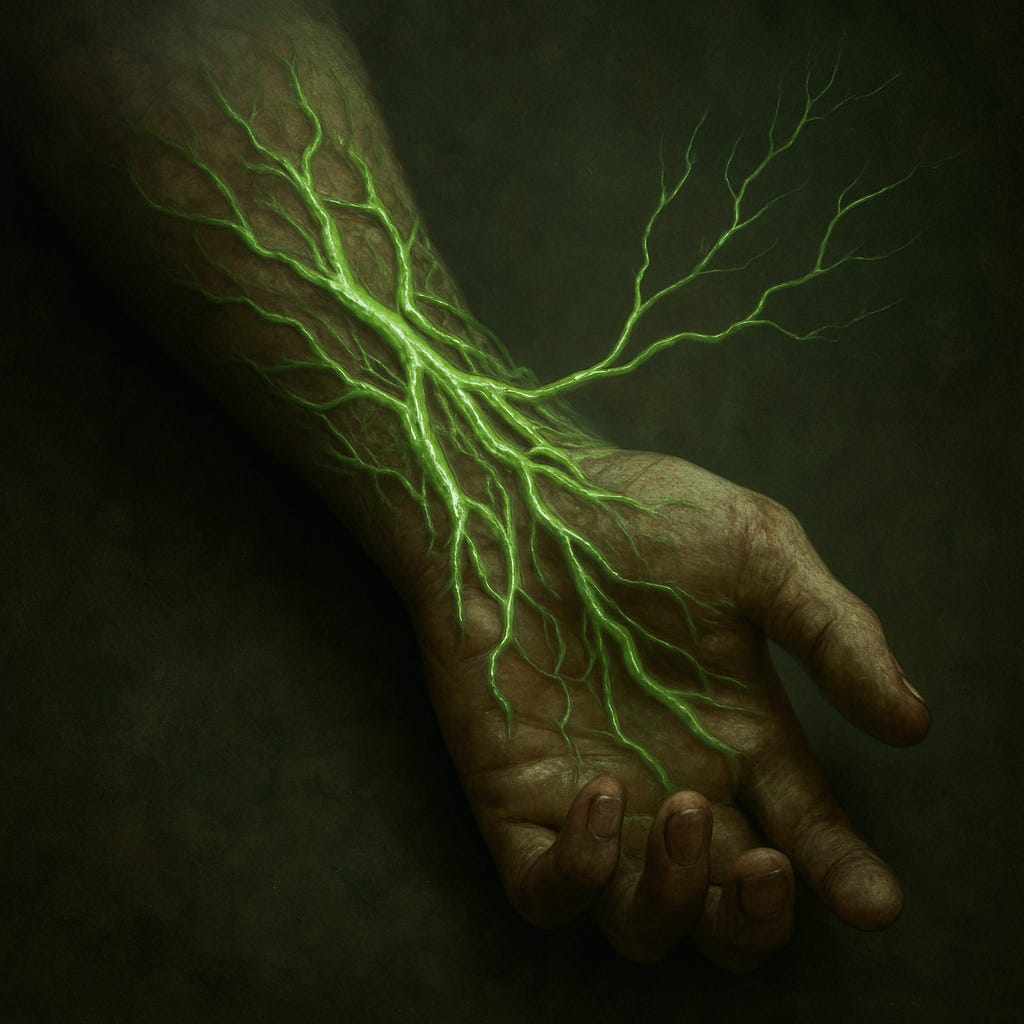
When I’m needed somewhere — when something is wrong — my veins pulse with green light, like the red and blue lights that used to be on my car. My eyes produce these microscopic spores, like tiny motes of pollen or something, and I can see differently — see more.
There’s usually some kind of path for me to follow that leads me to where I need to be. I don’t really understand how it works. I just know it does.
And I know when I don’t follow the path… The one time I didn’t, I found out those spores could do more than just show me the path. They turned inward, and the tissue behind my eyeballs began to necrotize. I can’t even begin to describe the pain.
Let’s just say I always follow the path now.
The lights beneath my skin came first — a warning that the earth had need of me. Then a brief burning behind my eyes, sharp and sudden, like someone struck a match behind the sockets. Then a ribbon of brightly shining green stars popped into view one by one — a small Milky Way galaxy of purpose leading me out of the house and down to the street.
The path doesn’t care about manmade things like roads or buildings. Since time is often short, I keep a bike under my porch for such moments. Combustion engines aren’t exactly encouraged anymore — not unless you’ve got a damn good reason.
I followed the floating stars in my vision down the road toward the edge of town, where a large abandoned barn leaned alarmingly toward the ground. Flashes of colored light and bangs and small booms emanated from behind the aluminum siding.
I heaved a sigh. Those goddamn kids again. Every time they got their hands on fireworks we went through this.
I leaned the bike against the barn siding and walked in. As expected, a small group of young teens was laughing wildly and trying to show each other up as they lit cherry bombs and M80s, firecrackers and silver salutes and tossed them up at the ceiling or into the building’s darkened corners.
I recognized all of them except one girl — she was a stranger to me, which was unusual.
“Enough!” I bellowed as loudly as possible, which was damn loud given my enlarged chest. Part of my fog metamorphosis included expanded lung capacity.
Five kids stopped as though they’d suddenly frozen solid, but the sixth — the unknown girl — looked me right in the eye, flashed a cheeky grin, and lit the bottle rocket in her hand.
Shit. She dropped the firework, ran for the door, and I took off after her. Kid was damn fast, and she knew it. She kept glancing back at me like this was a game — like she wanted to see how close I’d get before I gave up. I put on a burst of speed, but she was somehow staying ahead of me, despite being at least a foot shorter.
And my spore vision wasn’t leading me to her. It had vanished. Like she’d stepped out of range — or out of nature altogether. Something was very wrong here.
She ran, and I chased. Felt like a long time, but was probably less than ten minutes before she finally tripped on a hidden root in the grass and went flying headlong. Entirely possible that root wasn’t even there a few seconds earlier.
I was on her in seconds, and I grabbed her wrists and pulled them behind her back, slapping on the handcuffs. I don’t normally cuff kids. But this one didn’t act scared. She acted like she’d already won.
That kind of confidence gets people killed out here.
To make it worse, she wasn’t even hot from the run. No sweat. No heat. No scent of anything natural. Like she’d been sealed off from the world. Coated with shellac. Even with my lungs, I was puffing and blowing and sweating from every pore.
Every time I think I know how things work these days, something strange happens and shows me I still don’t get it.
“You done?” I asked. She shrugged like we were at a track meet, not two seconds from something far worse than detention. Her grin was too wide. Too easy. She didn’t know yet. I almost envied her for that.
I crowded into her space to intimidate her into telling me where to find her parents. As I leaned in, I expected to see fear, or at least defiance. But her pupils dilated way too fast when I got close — like animal eyes. I blinked, and it was gone. Maybe I imagined it. Maybe not.
“You caught me,” she said with a huff. “If I hadn’t tripped, I’d have gotten away. No old man’s gonna catch me.”
“Not just an old man, kid. I’m the sheriff,” I said, pulling her to her feet. She was oddly heavy for her height, like her bones were made of metal. “Catching people is my job.”
“Yeah, but my Mom said I’m special,” she pouted.
I snorted a laugh, “Yeah. Every mom says that about their kid. That’s her job.”
Her expression went from pouty to defiant real quick then. “Not my mom. Her job is as a scientist. And she’s the best at it.”
Hm. That was interesting. And it told me exactly who she was. In our small town, there was only one person who could legitimately be labeled a scientist — Dr. Phoebe Snow. She had been some bigwig CDC doctor before the fog rose; she’d moved into the old Baker place on Sugar Lane a few months back.
At least I knew now why I didn’t recognize the kid. I radioed for a car and watched the spores swirl in the distance — still dancing around the other kids. Still ignoring this one.
I didn’t say much on the walk back to the barn, and she didn’t either. She just swung her cuffed wrists behind her like we were walking back from gym class. Every so often she glanced at me sideways, testing how far the leash stretched. I gave her nothing. I’ve dealt with enough cocky teens to know the worst thing you can do is let them feel interesting.
But she was interesting. That was the problem.
The other kids were gone by the time we got back, scattered like crows after a gunshot. Fine by me. If the Earth had a problem with them, I’d be feeling it. I wasn’t. The spores were calm again — drifting gently like fog, like nothing had ever gone wrong.
Except it had. And she was the reason.
The car pulled up just as we reached the road. Quiet thing — barely a hum. I opened the back and gestured for her to climb in.
She looked at me like I was asking her to jump into a coffin.
“Seriously?” she asked. “You’re hauling me in for fireworks?”
“Just one,” I said, “but you lit it after the sheriff told you to stop. And after the Earth told me to come find you.”
That made her pause. Really pause. Just for a few heartbeats.
Then she tilted her head curiously and asked, “Why would the Earth care about me?”
I didn’t answer. Mostly because I didn’t know. But also because I had a suspicion maybe the Earth wasn’t actually watching her. And that was deeply disturbing.
She slid into the backseat like she was doing me a favor. I got in up front, tapped the console to set it rolling, and leaned back with a long sigh.
Ten minutes to the station. Ten minutes to figure out what the hell I was supposed to do with a kid the Earth couldn’t see…
I stared at the console for a second, then changed the destination. Sugar Lane. If I was right, her mother would be waiting.
I wasn’t bringing her in. I was taking her home. That felt worse somehow.
Fifteen minutes to Sugar Lane. Fifteen minutes to figure out if I was about to arrest a scientist — or bury one.
The Sugar Lane turnoff looked almost the same as it had five years ago — a cracked ribbon of asphalt barely wide enough for two cars, flanked by shoulder-high grass and waist-high fences. But the world had moved on, even if the road hadn’t. The fences had collapsed inward under creeping vines, and the grass was thicker now. Wilder.
I felt it well before I saw the house.
The Earth didn’t like it here.
The spores in my lungs had been dormant since the girl lit that fuse. Now they stirred — not guiding me, just… restless. Like dust catching a static charge. It didn’t hurt, but it itched somewhere deep behind my sternum. Like my own body was trying to warn me, but it wasn’t sure where the danger was coming from.
The Baker place stood at the end of the lane. Still white, mostly, though the paint was peeling like sunburn. The second story had blackout curtains nailed to every window, and the roof had a makeshift greenhouse rigged with salvaged solar panels and irrigation tubes. It looked like someone had tried to terraform a two-story farmhouse. Looked like maybe it was working.
The girl — I still didn’t know her name — leaned her forehead against the car window, watching the house come closer. Her cocky smile was gone now. She looked like a kid again. Small. Tired. A little scared.
“You okay?” I asked without looking back.
She didn’t answer.
I parked at the edge of the gravel and killed the ignition. The spores didn’t move. Not forward, not back.
That wasn’t comforting. I used to think it’d be great if they were gone, but I guess I’d come to rely on the earth’s guidance more than I realized.
I stepped out and opened the back door. The girl didn’t move.
“You gonna make me carry you?”
She shook her head, sighed, but still didn’t speak. Just slid out and stood there, staring at the front door like she was waiting for someone to open it.
Or waiting for someone to tell her she didn’t have to go in. I twirled her in place and unlocked the cuffs. Didn’t need to make a mama bear angry if there was no need. The girl tossed me a half smirk and headed up the walk.
She didn’t knock. She just reached up and opened the door like she lived there, which I suppose she did.
I followed her in.
The air hit me first — crisp and cool, but wrong. Too clean. Filtered and processed. Like the old air conditioning we used to have. No mold, no pollen, no dust. No life. Even the spores in my lungs recoiled. Not from fear, but rejection. Like they’d been shut out of a room they didn’t have clearance to enter.
The house wasn’t just clean; it was sterile.
The walls had been painted white, the kind of white you only see in surgical theaters, padded rooms, and nightmares. The floors were sealed concrete. The furniture was minimal — a table, two chairs, a couch still wrapped in plastic. One hallway glowed faintly blue, like UV lamps were running somewhere just out of sight.
The girl dropped into the nearest chair and propped her feet on the table like this was just another Tuesday. I stood in the doorway, unsure if I’d stepped into someone’s house or the kind of lab you should bury in the desert.
Then she walked in.
Dr. Phoebe Snow looked exactly the way I remembered her from the town hall meeting three months back — tall, angular, vines extruding from her skull and pulled into a tight knot at her neck. That had to hurt.
She wore a charcoal jumpsuit under a white coat with reinforced seams and sealed cuffs. She looked like she expected to be exposed to something but sure as hell didn’t plan to let it touch her.
She stopped when she saw me.
And when she saw her daughter, she flinched. Just once. Then she smoothed her expression back into something professional and blank.
“You brought her home,” she said.
“I figured the Earth sent me for a reason,” I replied.
She looked past me toward the open door, then back again. “Is it… watching?”
“I don’t know,” I said. “But it didn’t follow me in.”
That got a reaction. Just a flicker of something behind her eyes. Not panic — calculation.
“What did she do?” she asked, gesturing toward her daughter.
“She broke at least three post-Fog regulations,” I said. “And set off an explosive during dry season. You’re lucky the spores didn’t ignite.”
Phoebe’s eyes narrowed. “My daughter is immune.”
“Yeah,” I said. “I noticed.”
She didn’t answer, but she looked worried now.
“I also noticed the spores didn’t guide me to her,” I continued. “They didn’t respond at all. Until I got near your house.”
That got her. Not much. But enough.
“I think,” I said, “you’ve figured out how to hide her. Not just from the spores, but from the Earth.”
Phoebe looked at me like I was a particularly stupid student interrupting her lecture.
“I didn’t hide her,” she said. “I protected her.”
I paused. If she meant what I thought she meant, this could be… important.
“From what?”
“Mutation. Degradation. Reprogramming.” Her tone was flat, scientific. “You call it adaptation, but what I’ve seen — what I’ve recorded — is physiological collapse rebuilt by environmental override. That’s not symbiosis. It’s not even evolution. It’s parasitic control.”
“You’re saying the Earth’s a parasite?”
“I’m saying it doesn’t care what it turns us into,” she answered angrily. Yeah, this woman was full-on pissed off at the world.
I crossed my arms and leaned against the wall, careful not to touch anything. “Worked out fine for you.”
She tilted her head, eyes narrowing. “Did it? I had no control over my changes. I tried to stop it. Controlled my exposure. Set specific thresholds. I didn’t surrender my biology. It was taken.”
“And your daughter?”
Her lips pressed into a hard line.
“You blocked it from her,” I said. “You shut out the spores. Filtered the air. Purged her immune response. What else?”
Phoebe took a step closer. “She’s stable. Healthy. Human.”
“She’s not visible to the Earth.”
“Exactly,” her voice was proud now — too proud.
“I built her an immunity. Not from disease. From judgment.”
Something deep in my chest twitched. The spores pulsed once, sharply. Not a path. A warning.
“You really think you can out-engineer the planet?”
She didn’t answer.
“You think immunity is protection,” I said. “But what if it’s exile?”
She flinched. Just slightly. Then regrouped.
“She deserves a choice,” Phoebe said. “The others… they didn’t get one. We were rewritten. All I did was give my daughter time. Enough time to decide for herself what to become.”
I wanted to believe her. Hell, part of me did.
But I remembered how the spores had gone silent. How the grass hadn’t bent beneath the girl’s feet. How I heard no birds or crickets on Sugar Lane.
“You didn’t give her time,” I said. “You took her off the map.”
I shook my head sadly. “You took her out of the world. Like you learned nothing from the fog.”
The girl was listening. A small gasp escaped her after I spoke. “Am I broken?” she whispered. “Will the Earth ever… notice me?”
Phoebe’s mouth opened to answer her daughter, but no sound came out.
She staggered back a step, then reached up — not dramatically, not even consciously — to scratch her throat. A flicker of green trailed her fingers.
Her daughter gasped.
“What’s happening?” the girl whispered.
Phoebe turned toward the hallway, toward the sterile hum of the lab beyond, but the spores had already begun to stir. I could see them now — not my own, not the ones I carried, but wild ones. Blooming in the corners. Rising from the floorboards.
The Earth had waited. Maybe it had needed to know why.
But now it knew.
Her knees buckled, and I caught her before she hit the ground. Her body was slack in my arms, her breath shallow, and the veins at her temples glowed faintly green.
The Earth hadn’t punished.
It had judged.
Her daughter stared at her in horror, then at me. “Is she going to die?”
I looked down at Phoebe. Her eyes were open, but different — lit faintly green from within, like sap catching the sun. The vines she’d tied so tightly at the nape of her neck were suddenly free and growing.
“I don’t think so,” I said quietly. “But the Earth decides what she does now.”
The girl collapsed, hard, on the floor, tears welling in her eyes. I crouched beside her.
“You’re not broken,” I told her. “But you’re not invisible anymore either.”
Now the Earth was listening to her. Maybe it always had been…
Outside, I could hear crickets again.
—
‼️ If you liked this, you may want to read some of my other fiction.
Or share it with a friend…
💀 Enjoyed this story? Buy me a cup of existential dread and help keep the post-apocalyptic drama brewing.
There’s something profoundly unsettling, and moving, about this idea of the Earth as both witness and judge to human affairs. It reminds me of a few books but in an entirely unique way. I really love the idea of a sort of ahuman agency that comes to bear on what calls itself human. I love how this story never tips into cliché or goes the way of apocalyptic; instead, it gives us this eerie moral ecosystem where conscience, biology, and ecology have fused into one. Really, really enjoyed this!
A wild little tale Jenifer! Gave me vibes somewhere amidst Day of the Triffids and Body Snatchers fused with something that would drop out of a Dean Koontz's fever dream.