

Author’s Note:
This was inspired by the May 2nd prompt from Bradley Ramsey’s Halls of Pandemonium challenge, though I didn’t participate in the challenge. It was just a really cool prompt!
“He’s aboard,” Hildy said with quiet intensity. “I saw him.”
I nodded, swallowed, and tried to sound certain when I answered. “Then it begins.”
She turned to go, then stopped and whirled to face me. Her eyes were wide and full of tears that she’d never let fall. Hildy was strong that way. Always had been.
I grabbed her hand and tugged her into an embrace. For once, she didn’t fight me. Her arms slid around me and held me far tighter than I’d expected. But I hadn’t expected much — she’d been averse to physical affection all her life.
“I love you, sis,” she whispered. I opened my mouth to respond, but she was already pulling away and heading down the gangplank, her steps steady and determined.
“I love you, too,” I said to the emptiness where she’d stood.
I stood at the railing with the rest of the crowd and watched as we pulled slowly away from the dock, knowing if everything went as planned, I’d never see land again. I searched the waving, cheering crowds below for any sign of Hildy, but she was already gone.
I leaned on that railing staring out until land was completely out of sight. Everyone else had long since left to go about their first afternoon on board the greatest ship ever to sail the seas. I thought about all those shining, happy faces — so much excitement and hope.
And I was going to end it all for one man.
The rest of that day was spent wandering the corridors and public spaces of the massive vessel. I needed to know it inside and out. I’d studied the blueprints, of course, and every promotional photograph I could find. But I couldn’t rely on all of that to be completely accurate.
And I needed perfect accuracy. I needed to figure out where to use the acid. It would weaken the metal enough for my single explosive to do its job.
On the second day, I began exploring the parts of the ship where passengers were not usually allowed. It required some subterfuge, but I’d trained for this. A stolen stewardess uniform from an empty laundry room and a clipboard ensured no one really looked too closely or questioned my presence.
On the third day, I found what I wanted low on the starboard side at the back of a boiler room. It was hidden enough that my sabotage was unlikely to be found in time to prevent it. And if it all worked as Hildy had planned, the hole it created would sink the ship.
Then I’d have only one job left — ensure John Jacob Astor IV did not make it to a lifeboat.
I poured out all four vials of acid on the spot, then used the specially treated brush to spread it evenly across a large span of the hull. Then I left it to do its work.
Back in my stateroom, I changed into my fancy dress, put on makeup and pulled my hair into a chignon. I only had costume jewelry, but I doubted anyone would be able to tell without getting closer than I intended to let them.
I was determined to enjoy my last night.
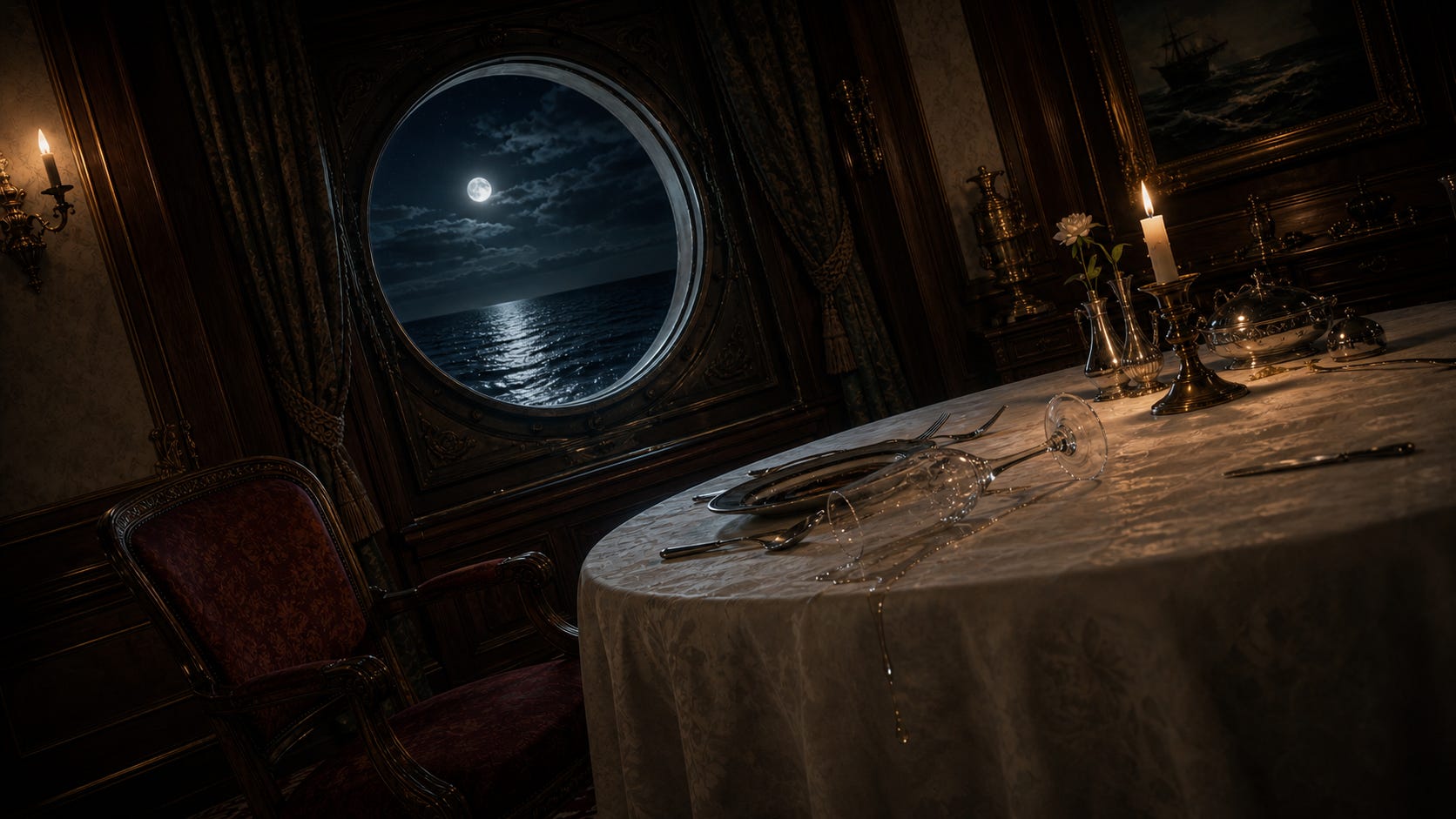
I settled into my seat in the main first class dining salon. The room was filled with laughing, talking people — couples in love, families enjoying their high seas adventure, stewards moving between tables with practiced smiles and gleaming trays.
The captain’s table was full of the wealthy and well-to-do. I was nowhere near it, of course. I tried to participate in the conversation happening at my own table, but listening to the everyday chatter of these strangers was painful. All my words came out stilted and unsure.
It was clear the other diners thought I was odd, at best. Though a young woman sitting near me — Elsie Bowerman — took pity and steered our conversation comfortably into easy topics. I was grateful for her kindness and was shocked to learn she was a suffragette and barrister — a woman who had made a life from refusing the place men assigned her.
After dinner, we strolled the promenade arm-in-arm, talking about books we both enjoyed. It was delightful. And… dreadful. The idea that my actions would lead to Elsie’s death left a hot stone in my stomach. The wonderful food I’d recently enjoyed threatened to return, and I excused myself quickly.
Elsie, kind as ever, offered to escort me to my stateroom and call the physician. But I begged her to continue her evening and go dancing without me. She hesitated, but eventually agreed, and we parted ways.
I hurried back to my room, certain with every step I was going to lose my dinner. And each person I passed made the weight in my stomach feel heavier. A couple gazed into one another’s eyes at the railing, soaking in the moonlight. A small girl ran laughing out of a stateroom chasing a ball into the corridor. An elderly man and woman held hands as they strolled down the corridor talking quietly.
They all seemed so… happy. Content. Peaceful. And I was going to end it. I didn’t have the right. I knew it.
But he hadn’t had the right either.
I stumbled into my stateroom and into the head, where I finally lost every bite I’d eaten in a rush of heat, foulness and sour champagne. Tears streamed from my eyes and I sobbed over the toilet, my stomach still roiling and angry.
At that moment, more than anything I wanted Hildy. Hildy would know what to do. She always knew what was right. She was so sure, and her certainty always made everything so clear. Nothing felt clear now.
My tears slowed, my sobs calming into hiccups and then the occasional whimper, until I sat quietly on the bathroom floor. I breathed deeply, trying to clear my mind — reminding myself again and again why I was here.
John Jacob Astor IV had to die. He’d earned his death. He’d killed my mother.
She’d worked for his family when they were young — a maid in their New York home. She’d been beautiful. Not just physical beauty; she’d glowed like she was lit from within by joy. I could still see her when I closed my eyes, green eyes sparkling and lips curved into a contagious smile.
Of course he’d been attracted to her. Everyone was. He’d romanced her. Maybe he loved her, maybe he didn’t. We didn’t know. When she’d gotten pregnant with Hildy, he’d moved them into a small cottage and taken care of her. He knew he had a daughter then. Hildy, at least, had been real to him.
He’d left to travel abroad, telling her that his parents insisted. He assured her he’d return and their life together could continue. Once he was gone, my mother had learned she was pregnant with me. The pregnancy had been difficult. She wasn’t able to work, and Astor hadn’t sent money since he left. She tried to reach him, to ask for help — to tell him about her second pregnancy.
But he hadn’t responded. She hadn’t heard another word of him until she learned he’d returned from the continent and married a socialite. She tried reaching out to his family, but they branded her a slut and a homewrecker.
My birth was extremely difficult for my mother. The midwife was unable to handle the blood loss, and she called a doctor. He saved both my mother and me, but she was weakened and never fully recovered. She died when I was just seven years old.
After that, it was just Hildy and me. They tried to separate us, put us into orphanages, but we clung together — two girls alone against a hostile world.
So we ran away. Lived on the street. We never had enough food. We fought for our very lives among a host of other castoffs from society. The only thing we had was each other. Hildy took care of me. Always. And now it was my turn to do something for her.
I took a deep breath, closed my eyes and nodded. My decision was made.
I slept well that night. My last night.
The next day I ate a good breakfast, spent a few hours basking in the sun, then donned my stewardess uniform. I smuggled the small bomb below deck in a laundry sack. It was surprisingly easy. Passengers never really looked at the staff. And the other stewards were all too busy going about their tasks to waste their attention on me.
Back in the boiler room, I used a mop handle to push at the steel, and with just a little effort it began to warp. The acid had done its work, weakening the steel.
I glanced up, imagining the faces of the people above me. So many innocents who had no idea what was coming. But this was what I’d promised Hildy I would do. I placed the bomb carefully in the center of the space and waited for nightfall.
Ideally, the majority of passengers would be in bed when the explosion happened. It would take time for everyone to get organized and make it to lifeboats, and even more time for the ship to sink. But we were far from any help in the middle of the North Atlantic. It was unlikely many would survive.
Hildy would handle things if he somehow survived. That was the plan.
I sprinkled a solid line of gunpowder from the bomb to the door, leaned down and lit it, then pulled the door firmly closed behind me. Then I ran.
I made it up almost two floors before the explosion sent a vibration through the hull. It wasn’t as loud or destructive as I’d expected. Instead it was almost a grinding noise rather than a boom. I looked back over my shoulder, worried it hadn’t done enough damage.
Then alarms began to ring somewhere above me. A few moments later, the great rumble of the engines came to a stop. I bit my lip worriedly, then continued my rush upstairs. I had to make sure Astor didn’t get on a lifeboat. Somehow.
First I headed to my stateroom and put on a dress, so I could move freely among the passengers. Then I headed toward the deck with a small, loaded pistol hidden in my handbag.
I wandered the deck for hours. The ship sank even slower than we’d predicted, passengers and crew gathering on the deck and milling about with fear and panic. But there was also so much courage. Some of the ballroom’s musicians began to play on the deck, helping to keep people calm. Stewards and crew members led women and children to lifeboats and made no attempt to board themselves.
It was… beautiful. And terrible. My heart broke again and again.
I gratefully watched a crewman help Elsie board a lifeboat at one point. She waved for me to join her, but I disappeared into the crowd.
Finally I saw him — differently this time. Not at the captain’s table, or in the grand staircase. Not laughing among men who believed the world had been made for them.
Instead he stood beside a lifeboat with his hand on his wife’s back. She was young. Pale. Frightened. And one hand rested protectively over the curve of her stomach.
She was pregnant.
For a moment, I saw my mother. I also saw his concern for this woman and her child. His child — a child that would be my sibling. And I was grateful the woman was escaping the wreck. I wanted the child to live — wanted my brother or sister to live. I wished I could tell Hildy about the child.
Then I saw Astor try to board the lifeboat, and I reached quickly for the pistol. But a crewman stopped him, and I heard him say, “Women and children first, sir.”
Surprisingly, he didn’t argue. He just nodded and stepped back, giving his wife a final nod. She reached for him, but they began lowering the lifeboat then. He watched her disappear down the side, then took a deep breath and turned away from the railing.
And our eyes met across the small distance between us. Maybe he saw something in my expression. Or maybe he saw my mother in me. I don’t know. But somehow he knew me. His eyes widened, his mouth opened, and he spoke. I couldn’t hear him over the music and the crowd. But I know what he said.
“Hildegard.”
He thought I was my sister. Of course he did. Hildy was the daughter he knew about. I was the one my mother never got to tell him existed. He moved toward me then, hurrying. And I stood, somehow unable to move. I’d never expected to speak with him. To really meet him.
I thought about the way he’d touched his wife. The expression in his eyes as he’d watched her disappear. The acceptance as he’d stepped from the rail. Maybe he wasn’t the monster we’d always thought. Maybe he’d just done a terrible thing.
I understood that. I’d done a terrible thing.
When he reached me, he held out a hand, and I almost took it. Almost. Then I pictured my mother’s face at the end — her gaunt, pale face, and the sparkle gone from her eyes.
And I turned and walked away.
As the ship sank into the night, the crowd cried and laughed and screamed. The music played. Bells rang. Beneath it all, the ocean surged.
It was victory. But it tasted like saltwater, smoke, and nothing.
‼️ If you liked this, check out some of my other random fiction that doesn’t quite fit into a specific genre.
🐒 Did this story make you roll your eyes, cough, or raise a brow? If it did, buy me a cup of existential dread and maybe I’ll write a little more.
I really enjoyed this short I was rooting for Hilde and wanted to see her father get his just desserts.
It's a solid backstory for a villain. I liked it!